Hero Image

Guide de l'Investisseur

Section 01
Business Congo

You can set up a business in Congo Brazzaville regardless of your nationality or place of residence. Registration takes a maximum of 48 hours. Foreign investors do not need a Congolese partner to get started.

All procedures are carried out at the one-stop shop of the Congolese Business Creation Agency (ACPCE). You can also complete formalities online at www.acpce.cg.

The most commonly incorporated company types in Congo are:

  • Limited Liability Company (SARL)
  • Public Limited Company (SA)
  • Sole Proprietorship
Decree 2018-180 of 30 April 2018: any sole proprietorship or SARL may use its director's home address as its registered office, provided a precise geographic address is given.

Upon submitting the required documents, the investor receives:

  • The Trade and Personal Property Credit Register (RCCM)
  • The business registration number (SCIEN)
  • The establishment registration number (SCIET)
  • The unique identification number (NIU)
Section 02

Two types of benefits are established under the Investment Charter and its implementing decree: preferential regimes and incentive measures.

Preferential Regimes

Regime G

For large companies making an investment of ≥ USD 200,000.

Regime S

For any company incorporated under Congolese law with an investment between USD 60,000 and USD 200,000.

Preferential Zone

Applies to any export-oriented company.

Incentive Measures

Export incentive

Any company exporting at least 20% of its output benefits from the removal of import duties and taxes, exemption from export duties on manufactured goods, and a zero VAT rate on exports.

Profit reinvestment incentive

Any company making new investments of at least one-third of existing fixed assets may benefit from a 50% reduction in corporate tax (IS) and personal income tax (IRPP) for 3 years.

Incentive for investment in landlocked areas

Full exemption from IS and IRPP during the first 3 financial years, then a 50% reduction in years 4 and 5.

Social and cultural investment incentive

A tax relief defined by order of the Minister of Finance, following a decision by the National Investment Commission (CNI).

Eligibility Criteria

The company must meet the following conditions:

  • Be registered in the RCCM
  • Create permanent jobs (≥ 280 days/year)
  • Have share capital ≥ 1/5 of total investment
  • Give priority to local raw materials
  • Be registered with the CNSS (social security)
  • Open an account with a local bank
  • Give priority to local labour, where skills are equivalent

Approval Procedure

The application is addressed to the minister responsible for the economy and submitted to the permanent secretariat of the National Investment Commission (CNI) at least one month before the commission meeting.

It must be submitted in 30 copies and include:

  • An application form
  • A feasibility study
  • Draft articles of association
  • A company formation and registration file
  • Pro-forma invoices for equipment
  • A technical opinion from the relevant ministry
  • Filing fee: USD 1,000
Section 03

The Environmental Compliance Certificate (CCE) is required before a project is authorised to proceed. It is issued by the Ministry responsible for the environment.

Two types of assessment are available depending on the scale of environmental impacts:

  • Environmental impact notice (simplified assessment)
  • Full environmental impact assessment

Government Policy on Environmental Matters

National policy aims in particular to:

  • Contribute to sub-regional, regional and international environmental protection efforts
  • Ensure food security and the supply of products in adequate quantity and quality
  • Promote job creation
  • Develop a policy for sanitation and control of urban and industrial pollution
  • Harmonise existing environmental laws and regulations
  • Ensure compliance with International Conventions and Treaties signed by Congo
Section 04

The administrative steps required to set up a business take approximately one week, provided investors have all the necessary documents. The launch of the one-stop shop is expected to further simplify the process and shorten timelines.

The processes for obtaining environmental permits are considered clear and affordable. Investors active in the mining sector regard the current code as business-friendly.

Section 01

According to the World Bank, the population of the Republic of Congo is estimated at 5,125,821 inhabitants. It is characterised by its youth (40.7% are under 15) and an annual growth rate of 2.6%.

The population is concentrated in Brazzaville (37.14%) and Pointe-Noire (19.35%), with an urbanisation rate of 61.8%. The official language is French.

Workforce Skills

The Congolese education system comprises four levels: pre-school, primary, secondary and higher education, as well as technical and vocational training. Teaching is conducted in French.

The Directorate General for Vocational Training and Employment (DGFQE), established in 2010, aims to bring a skilled workforce to the labour market. ONEMO maintains databases of job seekers.

Higher Education

Marien Ngouabi University in Brazzaville is the only public institution, comprising 5 faculties, 3 university institutes and 3 professional schools. It offers programmes in economics, law, IT, medicine, agronomy, engineering, etc.

Since 2012, the government has been constructing a new university in Kintélé with a capacity of 30,000 students.

Section 02

Indicative average salaries for selected positions (2018):

PositionCurrencyAmountNote
Senior DirectorUSD2,200 – 3,500per month
Senior ManagerUSD1,600 – 3,000per month
EngineerUSD1,600 – 3,000per month
Graduate TraineeUSD1,500per month
Administrative AssistantUSD750per month
Skilled TechnicianUSD750per month
MechanicUSD650per month
DriverUSD400per month
Minimum WageUSD240per month
Section 03

Affiliation with the National Social Security Fund (CNSS) is compulsory for all employers with salaried staff.

BranchEmployer's share (%)Employee's share (%)
Family benefits (incl. maternity)10.030
Workplace accidents / occupational diseases2.250
Pensions84
TOTAL20.284
Section 04

Employment is governed by the Labour Code. The statutory working week is 40 hours. Employees are entitled to 26 working days of annual leave.

Permanent Contract (CDI)

A CDI may be written or verbal, full-time or part-time. The probationary period may not exceed: 15 days (hourly-paid workers), 1 month (monthly-paid employees), 3 months (supervisory staff and managers). It may be renewed only once and must be done in writing.

Fixed-term Contract (CDD)

A CDD must be in writing (otherwise it is presumed to be a CDI). Its duration may not exceed 2 years, including any renewal. It may be renewed only once for a period equal to or shorter than the initial term.

Labour Dispute Resolution

Disputes are resolved amicably or through the courts, before the Labour Tribunals in the place of work.

Section 05

Notice periods depend on collective agreements. As a general rule: 1 month (workers/employees), 2 months (supervisory staff), 3 months (managers).

Redundancy Pay

Scale based on the average monthly salary over the last 12 months:

  • 25% per year — for the first 5 years
  • 30% per year — from year 6 to year 10
  • 35% per year — from year 11 to year 15
  • 45% per year — beyond year 20
Section 06

Any foreign national may take up paid employment in Congo. No quota is set on the number of foreign employees. However, a company may only recruit foreign workers if the required skills are unavailable on the local market.

Employment contracts for foreign nationals must be in writing and are subject to a visa issued by the Minister responsible for Labour.

Section 07

Investors report that they can readily find administrative managers. However, filling technical and engineering positions remains a challenge. Some companies recruit skilled workers trained in other countries in the region.

Although simplification has been effective, expatriate workers remain expensive and administrative processes relatively lengthy.

Section 01

The production, distribution and sale of electricity is handled by Énergie Électrique du Congo (E2C), a public limited company created in 2018. Output has grown from 89 MW in 2000 to over 590 MW today.

Main power plants: Djoué (15 MW), Moukoukoulou (75 MW), Djeno gas (22 MW), Imboulou (30 MW), Liouesso (19 MW). Hydroelectric potential estimated at 14,000 MW.

Projects under way: Sounda dam (600+ MW), Nkouembali (150 MW), Chollet (600+ MW). PPPs are encouraged.

Section 02

Water distribution is handled by La Congolaise des Eaux (LCDE). Water resources are estimated at 1,588 billion m³/year, of which only 13% are currently exploited.

CurrencyAmountNote
WaterUSD0.26price per m³
Bi-monthly subscriptionUSD25.40"by-pass" flat rate
Section 03

Three mobile operators: MTN Congo, Airtel Congo and Azur Congo. Fixed-line telephony is managed by Congo Télécom (monopoly). Congo has over 5,000 km of fibre optic networks.

OperatorCurrencyAmountNote
MTN CongoUSD12050 GB/month
Airtel CongoUSD12050 GB/month
Congo TélécomUSD70512 Kbps/month
Phone callUSD0.17Average price/min to other networks
Section 04

🛣 Road network

~22,745 km, of which 3,513 km are paved. The RN1 Brazzaville–Pointe-Noire highway (540 km) has been fully paved since 2015.

🚂 Rail

795 km of track. The CFCO connects Brazzaville to Pointe-Noire (510 km). Rehabilitation under way (PPP sought).

✈ Aviation

3 international airports: Brazzaville (Maya-Maya), Pointe-Noire (Agostino Neto), Ollombo. Managed under concession by Egis.

⚓ Port of Pointe-Noire

The only deep-water port in the sub-region. Handles vessels of 230 m 24/7. Slipway capacity of 700 tonnes.

Section 05
ItemCurrencyUSD amountNote
PetrolUSD1.19per litre
DieselUSD0.95per litre
Gas cylinder (12 kg)USD12excluding cylinder cost
2-star hotelUSD160room + breakfast
3-star hotelUSD240room + breakfast, Brazzaville
TaxiUSD2single trip in the city
Rice (1 kg)USD2.40
Cement (50 kg)USD11
Section 06

Infrastructure sometimes limits project development and increases production costs. Electricity costs are low but supply is not always reliable. Many companies operate their own generators.

Some projects in the mining sector require infrastructure that does not yet exist and demands significant investment.

Section 01

The national land area comprises the public domain (State and local authorities) and private land owned by individuals. State domain management remains exclusively within the State's competence.

Foreign nationals may access land through:

  • A provisional occupancy permit
  • An ordinary lease (max. 18 years)
  • An emphyteutic or long-term lease (18 to 99 years)
Section 02

Land registration is compulsory. It is carried out at the Directorate General of Taxes and Domains. The land title is final and unassailable, identified by a registration number.

Dispute Resolution

Disputes over registered land fall under the jurisdiction of the competent court of first instance for civil matters.

Section 03
TypeCurrencyUSD amountNote
City-centre officeUSD68price per m²
Street-level retailUSD70price per m² in city centre
Furnished house (3 rooms)USD54price per m²
Section 04

Three categories of permit depending on the type of construction:

Category 1

Ground floor, footprint ≤ 300 m². Processing time: 10 working days.

Category 2

Multi-storey construction. Processing time: 25 days.

Category 3

Constructions of national interest (hospitals, factories…). Processing time: 30 days.

Section 05

The Government has decided to create 4 special economic zones (SEZs) to diversify and industrialise the economy:

SEZ Brazzaville

164,100 ha on the banks of the Congo River

SEZ Pointe-Noire

2,790 ha — the first to be established (Law No. 19-2018)

SEZ Oyo/Ollombo

760,318 ha on the banks of the Alima River

SEZ Ouesso

64,520 ha on the banks of the Sangha River

Section 06

Investors appreciate access to land for both nationals and foreigners. However, they recommend accelerating the special economic zones project.

Section 01

The Congolese tax system is self-assessment based, founded on the General Tax Code of 2012. The tax authority has a right of review up to the 4th year. It covers taxes on income, expenditure, capital and economic activity.

Section 02

Any person commencing a profit-making activity must, within 15 days of starting, file a declaration with the Directorate General of Taxes and Domains.

Taxes are paid exclusively by bank transfer to the Public Treasury. Payment deadlines fall between the 10th and 20th of each month.

Section 03
CategoryRate (%)
Standard rate30
Microfinance and private education25
Mining, quarrying, real estate30
Foreign legal entities under ATE35
Section 04
Income bracketRate (%)
≤ 464,000 FCFA1
464,001 – 1,000,000 FCFA10
1,000,001 – 3,000,000 FCFA25
> 3,000,000 FCFA40
Section 05

Rate: 20%

of the taxable capital gain, applicable to disposals of shareholdings in Congolese-law companies by persons domiciled abroad.

Section 06

Rate: 7.5%

of gross salary (wages, bonuses, allowances, benefits in kind). Payable by any employer with one or more salaried employees.

Section 07
Product categoriesRate (%)
Standard taxable transactions (normal rate)18
Basic consumer goods, imported diesel (reduced rate)5
Exports and international transport (zero rate)0
Section 08

Based on the previous year's turnover excluding tax. A 10-bracket scale with degressive rates:

Turnover bracketRate
Turnover < 1,000,000 FCFA10,000 FCFA (flat fee)
1M – 20M FCFA0.750%
20M – 40M FCFA0.650%
40M – 100M FCFA0.450%
100M – 300M FCFA0.200%
300M – 500M FCFA0.150%
500M – 1Bn FCFA0.140%
1Bn – 3Bn FCFA0.135%
3Bn – 20Bn FCFA0.125%
> 20Bn FCFA0.045%
Section 09
Product typeCategoryDuty (%)
Essential goodsI5
Raw materials and capital goodsII10
Intermediate and miscellaneous goodsIII20
Consumer goodsIV30

Double taxation agreements:

Congo has signed tax conventions with: CEMAC member states (1966), France, Italy, Mauritius and Tunisia.

Section 10

There is a lack of coordination between the agencies responsible for tax collection. Many investors have noted a proliferation of tax audits and an increase in para-fiscal levies in the context of budget deficits.

Section 01

The Congolese Investment Charter guarantees the freedom to carry out any agricultural, mining, industrial, forestry, craft, commercial or service activity to any person, regardless of nationality.

Congo is also a signatory to all acts of the OHADA Treaty (Organisation for the Harmonisation of Business Law in Africa), which has 17 member states.

Section 02

Freedom to import/export raw materials, capital goods and products required for economic activities

Freedom to determine production and marketing policy

Freedom to choose customers and suppliers and set prices

Non-discrimination on grounds of nationality — equal treatment

Expropriation

Expropriation is only permitted "for reasons of public interest" (Law No. 11-2004). The expropriated party is entitled to fair and prior compensation, determined by mutual agreement or by court ruling.

Capital transfers

The transfer abroad of income from any investment is guaranteed to persons who have met their tax obligations. Remittances abroad are subject to a tax of 1.5% of the gross amount transferred.

Dispute resolution

The Congo Mediation and Arbitration Centre (CEMACO) provides an alternative recourse. Congo is a signatory to the ICSID Convention and recognises the OHADA Common Court of Justice.

Bilateral agreements

8 bilateral investment protection agreements in force: with Italy, South Korea, the United Kingdom, China, Switzerland, Mauritius, Germany and the USA.

Section 03

Congo has been a member of WIPO since 2 December 1975. It is a signatory to the Paris and Berne Conventions, and a member of OAPI (African Intellectual Property Organisation).

Patent protection lasts a maximum of 20 years from the date of filing. Copyright is protected throughout the author's lifetime and 50 years after their death.

Section 04

Law No. 6-94 of 1 June 1994 guarantees freedom of trade by prohibiting anti-competitive practices. The Electronic Communications Act (2009) and the Public Procurement Code (2009) reinforce this framework.

Section 05

Investors have raised no concerns regarding the protection of their rights or the repatriation of funds abroad.

Section 01

As an investor in Congo, you gain access not only to the domestic market, but also to the CEMAC and CEEAC zone, totalling over 174 million inhabitants, as well as preferential access to developed country markets.

5.1M
Inhabitants – domestic market
174M
Inhabitants – CEMAC/CEEAC market
77M
Consumers (neighbouring DRC)
370M
Inhabitants – Great Lakes Region
Section 02

Congo has been a WTO member since March 1997 and benefits from preferential access under two major agreements:

🇺🇸 AGOA (United States)

Duty-free access for an additional 1,800 products, including textiles and clothing.

🇪🇺 EBA (European Union)

Duty-free access for all goods, except arms and ammunition.

Section 03

Congo has over 10 million hectares of arable land (less than 10% currently used), annual rainfall of 1,200 to 2,000 mm, and is one of the most water-rich countries in Africa.

Investment opportunities:

  • Beef, poultry and egg production
  • Construction and operation of slaughterhouses
  • Fruit production and processing
  • Setting up tractor assembly units
  • Creation of companies producing seeds, animal feed and fertilisers
Section 04

Tourism is identified as the 2nd most promising sector after agriculture in the National Development Plan 2018–2022, with a target contribution of 10% of GDP.

Congo has 4 national parks, 9 reserves and a rich cultural heritage (Poto-Poto School of Art, FESPAM, De Brazza Mausoleum, etc.).

Opportunities:

  • Development of national parks (Odzala, Nouabalé Ndoki…)
  • Construction of 4- and 5-star hotels
  • Creation of the Tourism Training Institute (IFT)
  • Construction of a tourist complex on Mbamou Island
  • Amusement parks in Brazzaville and Pointe-Noire
Section 05

Congo holds significant mineral resources: iron ore, potash, phosphate, polymetals, gold and diamonds. The country could produce 100 million tonnes of iron ore per year within the next decade.

Oil accounts for 90% of exports and over 70% of public revenue. Production is estimated at 300,000 bbl/day (end 2017). Total reserves are approximately 2.2 billion bbl through to 2040.

10 PPP projects identified in the oil sector:

  • Construction of a new refinery in Pointe-Noire (3–4 Mt/year)
  • Pointe-Noire – Brazzaville – Ouesso pipeline
  • Methanol and urea manufacturing unit
  • Transformation of natural gas into an energy and industrial resource
  • Construction of new LPG storage facilities across the country
Section 06

Congo holds 22,263,000 ha of forest — the 2nd largest forest massif in Africa, covering ~65% of the territory. Annual sustainable yield is 2 million m³ of logs.

In addition, there are 73,000 ha of forest plantations (Eucalyptus, Limba, Pine).

Section 07

Financial sector

11 banks and 7 insurance companies. Opportunities in banking and insurance.

⚡ Energy

Construction of hydroelectric dams (Mourala, Sounda, Chollet…), renewable energy (solar, biomass).

Section 08

Despite a period of weaker economic performance, investors remain confident in the scale of the growth potential. They cite infrastructure projects, transport services and agri-food production among the sectors with strong prospects.

Section 01

⚓ Regional gateway — The deep-water port of Pointe-Noire (15 m draught) is the ideal starting point for accessing the West African coast.

Scalable market — Integration into CEMAC and CEEAC (174M+ inhabitants) and access to the Great Lakes Region (370M inhabitants).

Abundant natural resources — Oil, gas, potash, iron ore, 14,000 MW of energy potential, 10M ha of arable land, 22M ha of forest.

Legendary hospitality — Freedom to do business and to move around unmatched in neighbouring countries.

Emerging sectors — ICT (140% mobile penetration rate), agriculture, tourism, mining, energy, timber and transport.

Strong FDI tradition — Congo has been the top investment destination in Central Africa and the 3rd country in sub-Saharan Africa for attracting FDI.

Section 02
342k
km² total area
5.2M
Inhabitants (2018)
2,540
USD GDP per capita
12
Administrative departments
IndicatorValue
Official nameRepublic of Congo
CapitalBrazzaville
CurrencyCFA Franc — 1 EUR = 655.957 FCFA (fixed rate)
Official languageFrench
Other national languagesLingala and Kituba
Section 03
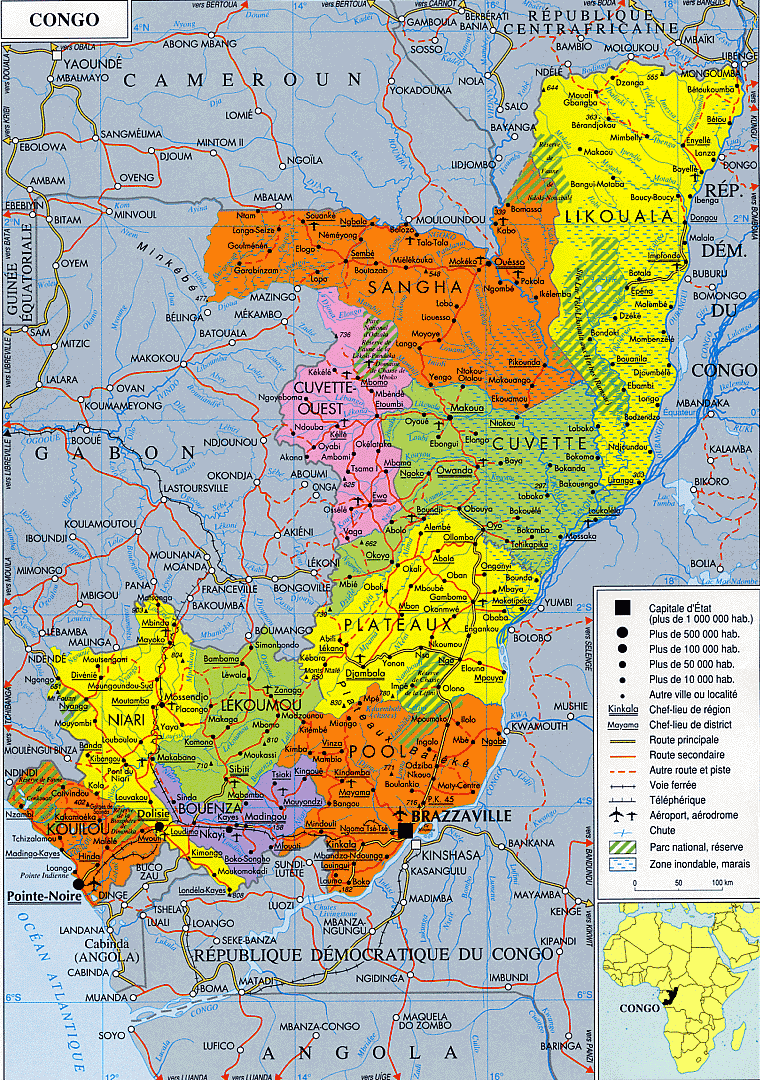
Map of the Republic of Congo